
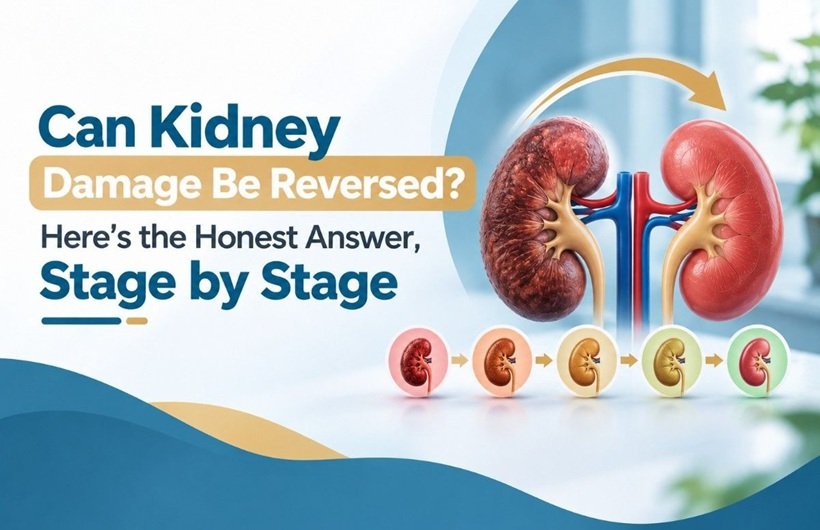
Your lab report just told you your kidneys aren’t working right. The first question on your mind is simple: can this be fixed?
The honest answer depends on your stage of chronic kidney disease treatment. We won’t pretend otherwise.
- Some kidney damage can be slowed.
- Some can be partly reversed.
- Some is permanent.
Even permanent damage can usually be managed well. Most patients protect their quality of life for years with the right care. If you’re looking for a nephrologist in Ahmedabad to explain your reports, you’re already doing the right thing.
Why “Reversible” Isn’t a Yes-or-No Question
Kidney damage isn’t one condition. It’s a spectrum.
Doctors track it with eGFR (estimated glomerular filtration rate). This number tells us roughly how much kidney function you have left. Chronic kidney disease (CKD) is staged from 1 to 5 based on eGFR. Reversibility depends on which stage you’re in.
Acute kidney injury is different. It’s caused by dehydration, certain medications, or a sudden infection. Catch it early, and it’s often fully reversible.
Chronic kidney disease works differently. Your kidney’s filtering units are called nephrons. Once scarred, they don’t regenerate.
But here’s what most patients don’t know: your kidneys have real reserve capacity. You can lose a meaningful portion of your nephrons and still feel completely normal. That’s exactly why catching damage early matters so much.
Stage 1 and 2: Damage Present, Function Mostly Intact
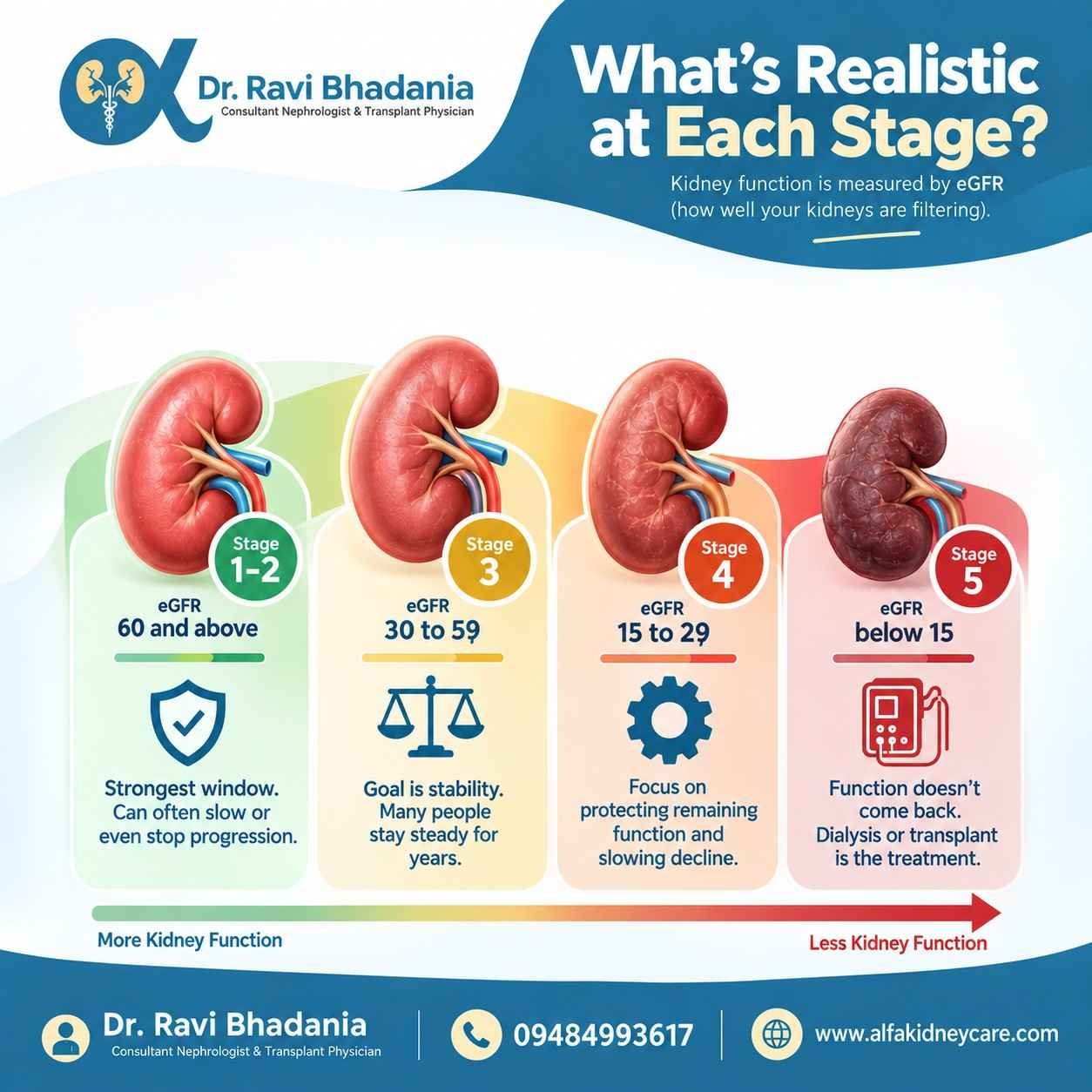
- Stage 1: eGFR of 90 or above, with signs of damage like protein in urine
- Stage 2: eGFR 60-89
At these stages, your kidneys are still doing most of their job. This is where “reversal” is most realistic. Scarred tissue doesn’t heal. But you can often stop further loss entirely. Some patients even see eGFR numbers improve slightly once the underlying cause is controlled.
What usually causes it:
- Early diabetes-related kidney changes
- High blood pressure
- A temporary reaction to certain painkillers
What changes the outcome:
- Managing blood sugar tightly
- Keeping blood pressure under 130/80
- Cutting back on NSAIDs like ibuprofen
Patients who act early often live for decades without progressing to advanced CKD.
Stage 3: The Turning Point
Stage 3 (eGFR 30-59) splits into 3a and 3b. It’s where most patients first get diagnosed, often because they had no symptoms before this point.
This is genuinely the turning point. Function you’ve already lost generally isn’t coming back. But how fast you lose more function is almost entirely in your control.
This is where a kidney friendly diet stops being optional advice. It becomes central to your treatment plan.
- Reduce sodium
- Manage potassium and phosphorus
- Control protein intake
Each of these lowers the workload on the nephrons you still have. Combined with blood pressure control and treating the root cause, many Stage 3 patients stay stable for years without progressing further.
Stage 4: Preparing, Not Panicking
At Stage 4 (eGFR 15-29), function is significantly reduced. The question shifts from “how do we reverse this” to “how do we protect what’s left.”
This doesn’t mean giving up. It means being realistic.
At this stage, you’ll benefit from:
- Closer monitoring
- Stricter dietary control
- Early conversations about dialysis or transplant options, before they become urgent
We tell every Stage 4 patient the same thing: start these conversations early, while you’re still feeling relatively well. Waiting until a crisis hits leaves you with fewer options. Planning ahead for dialysis and care, or getting evaluated for a transplant, gives you choices instead of emergencies.
Stage 5: Kidney Failure, Not the End of the Road
Stage 5 (eGFR below 15) is called kidney failure. Your kidneys can no longer keep up with your body’s needs on their own.
At this point, reversal isn’t part of the conversation. Dialysis or transplantation becomes necessary to sustain life.
But here’s the important part: kidney failure is a manageable condition, not an immediate crisis. Many patients on dialysis, or living with a transplant, lead full, active lives for years.
What Actually Slows or Improves Kidney Function
Across every stage except Stage 5, the same strategies matter most:
- Blood pressure control. Uncontrolled hypertension is one of the fastest ways to lose kidney function. Staying consistently under 130/80 protects the nephrons you have left.
- Blood sugar management. For diabetic patients, tight glucose control is directly tied to slower CKD progression.
- Reducing nephrotoxic medications. Regular NSAID use, and certain other drugs, can speed up damage. Always check with your doctor before long-term use.
- Dietary adjustments. Sodium, potassium, phosphorus, and protein all need individual limits based on your stage.
- Treating the underlying cause. Diabetes, hypertension, autoimmune conditions, recurrent infections, whatever the root problem is, treating it beats treating symptoms alone.
None of these reverse scarred tissue. What they do is stop further damage. In early stages, that’s often enough for eGFR to stabilize, or even tick upward slightly as inflammation resolves.
Warning Signs You Shouldn’t Wait On
Kidney disease is called “silent” for a reason. Early stages rarely cause symptoms. Watch for:
- Swelling in your legs, ankles, or around your eyes
- Persistent fatigue that doesn’t improve with rest
- Foamy or bubbly urine
- Changes in how often or how much you urinate
- Unexplained nausea or loss of appetite
- Muscle cramps, especially at night
Any of these sound familiar? Or do you have diabetes, high blood pressure, or a family history of kidney disease? A simple blood and urine test can tell you exactly where you stand. Dr. Ravi Bhadania regularly sees patients whose kidney disease was caught early enough to change the outcome, simply because they didn’t wait.
Conclusion
Kidney damage exists on a spectrum. Where you are on it determines what’s genuinely possible. Early-stage damage often responds well to lifestyle and medical management. Advanced disease needs a different kind of planning. At every stage, what matters most is knowing where you stand, not guessing.
Acute and Chronic Kidney Disease Treatment
Have you had abnormal kidney function results? Are you at risk and haven’t been tested recently? Don’t wait for symptoms to force the issue. Contact us to book a consultation, or call us directly to discuss your reports with Dr. Ravi Bhadania.
📅 Book Appointment 📞 Contact Us
Frequently Asked Questions
Q: Can Stage 3 kidney disease be reversed completely?
A: Full reversal to normal function is uncommon at Stage 3. But progression can often be stopped or significantly slowed with the right treatment plan. Many patients stay stable at this stage for years.
Q: Is a slightly low eGFR always a sign of permanent damage?
A: Not necessarily. Dehydration, certain infections, or recent illness can temporarily lower eGFR. Your doctor will usually repeat the test after a few weeks to confirm whether it’s a lasting change.
Q: Can diet alone reverse kidney damage?
A: Diet alone rarely reverses existing damage. But it plays a major role in slowing further loss, especially combined with blood pressure and blood sugar control.
Q: How often should I get my kidney function checked if I’m at risk?
A: If you have diabetes, hypertension, or a family history of kidney disease, get checked at least once a year, more often if you’re already diagnosed with CKD.
Q: Does kidney damage always lead to dialysis?
A: No. Most people diagnosed with CKD, especially in early stages, never reach the point of needing dialysis if the condition is managed properly.
This content is for informational purposes only and does not constitute medical advice. Please consult a qualified nephrologist for diagnosis and treatment tailored to your individual condition.