


You got your lab report back, scanned it for anything highlighted in red, and there it is: creatinine, above range. Before you spiral into a Google search at midnight, here’s what you need to know: a single high creatinine reading is common, and it doesn’t automatically mean kidney disease.
Creatinine is one of the simplest, most useful numbers your doctor looks at for precise diagnosis and treatment of kidney problems, but on its own, it’s just one data point. As a kidney specialist in Ahmedabad, we see this exact worry walk through our door every week: patients holding a lab report, unsure whether to panic. Here’s how to actually read that number.
What Is Creatinine, and Why Does It Matter?
Creatinine is a waste product your muscles produce constantly, as a natural byproduct of everyday muscle activity. Healthy kidneys filter it out of your blood and send it out through urine. When your kidneys aren’t filtering well, creatinine builds up in your bloodstream instead of leaving your body, which is exactly why doctors use it as a window into kidney function.
It’s a simple blood test, but it tells a surprisingly detailed story when read correctly, especially alongside a second number called eGFR (estimated glomerular filtration rate), which your lab usually calculates automatically from your creatinine, age, and sex.
What Counts as a “Normal” Creatinine Level?
Reference ranges vary slightly by lab, but as a general guide:
- Adult men: roughly 0.7 to 1.3 mg/dL
- Adult women: roughly 0.5 to 1.1 mg/dL
Notice the ranges differ by sex. That’s because creatinine production is tied to muscle mass, and men typically carry more muscle mass than women. Someone who’s very muscular, an athlete or a bodybuilder for instance, can have a naturally higher creatinine level without any kidney problem at all. Someone with very low muscle mass can have a “normal-looking” creatinine level while actually having reduced kidney function. This is precisely why a single number, without context, can mislead you either way.
What Causes a High Creatinine Reading?
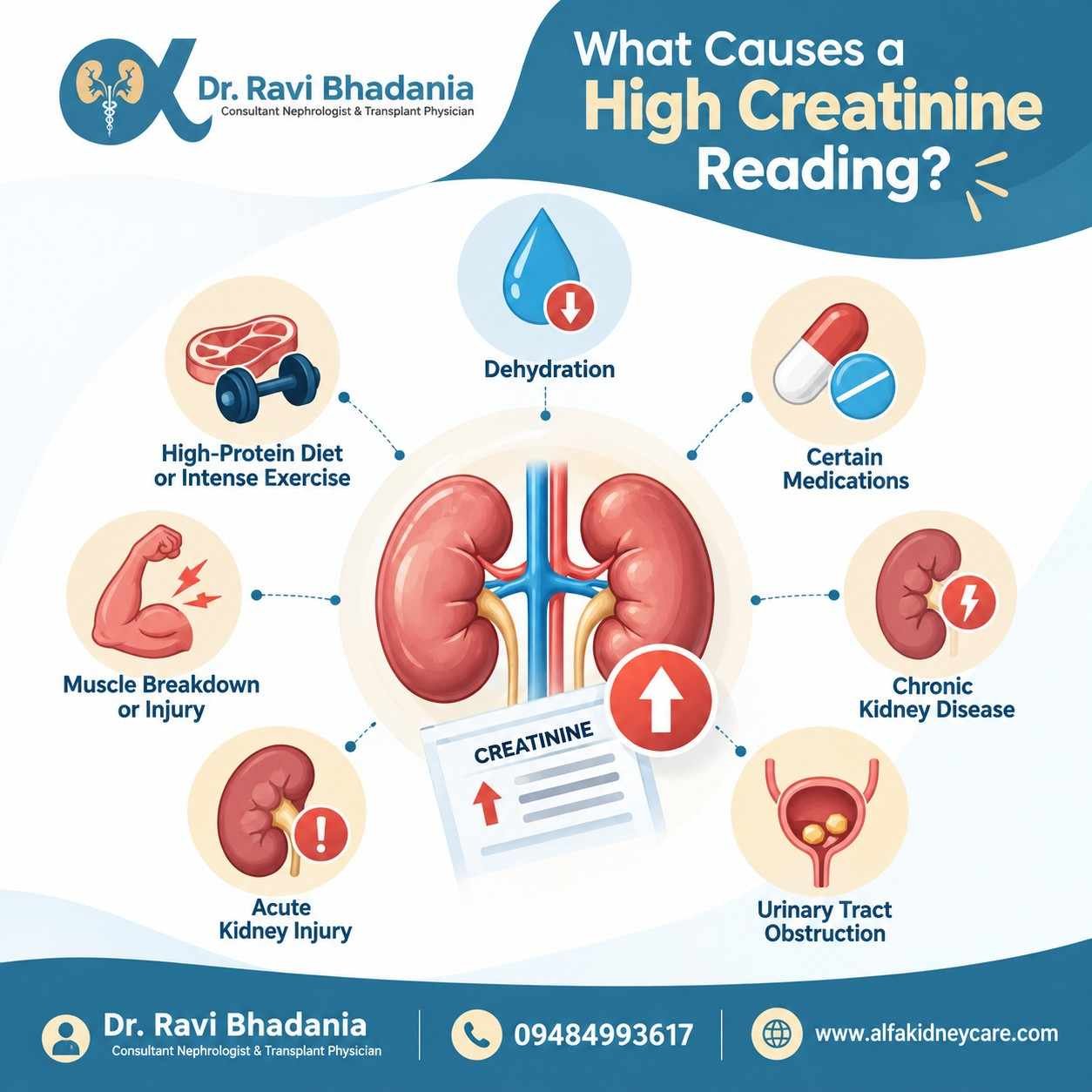
A high result doesn’t always point to kidney disease. Some of the most common causes we see include:
- Dehydration. Not drinking enough water before a blood test is one of the most frequent, most reversible causes of a mildly elevated reading.
- High-protein diets or recent intense exercise. Both temporarily increase creatinine production.
- Certain medications, including some painkillers, antibiotics, and blood pressure drugs, can raise creatinine levels or interfere with how the test reads.
- Muscle breakdown or injury, which releases extra creatinine into the bloodstream.
- Chronic kidney disease, where the kidneys have lost some of their filtering capacity over time.
- Acute kidney injury, a sudden drop in kidney function, often from infection, blood pressure crashes, or certain medications.
- Urinary tract obstruction, such as kidney stones blocking normal urine flow.
This list is exactly why we don’t jump to conclusions from one lab value. Context matters: your hydration that day, your diet, your medication list, and whether this is a one-time reading or part of a repeated pattern.
When Should You Actually Worry?
A single, mildly elevated creatinine reading, especially if you were dehydrated, just finished a hard workout, or recently ate a large protein-heavy meal, usually isn’t an emergency. What warrants a closer look is a pattern: creatinine that stays elevated across repeat tests, a level that’s climbed compared to your previous results, or a high reading paired with symptoms like swelling, reduced urination, fatigue, or high blood pressure.
If you’re diabetic, hypertensive, or have a family history of kidney disease, we’d recommend getting it checked even for a mild, isolated elevation, simply because your baseline risk is already higher.
How We Investigate a High Creatinine Result
When a patient comes to us with an elevated creatinine reading, we don’t treat the number in isolation. Our approach typically includes:
- Repeating the test, ideally with proper hydration and no recent intense exercise, to rule out a temporary spike.
- Calculating eGFR, which gives a clearer picture of actual kidney filtering capacity than creatinine alone.
- Checking urine for protein or blood, since these can point toward specific kidney conditions.
- Reviewing your medication list and diet, since several common drugs and supplements can affect the result.
- An ultrasound, if there’s any suspicion of obstruction or structural changes.
This step-by-step approach is how we tell the difference between a harmless, one-off blip and something that needs ongoing management, like early chronic kidney disease or, in more serious cases, monitoring similar to what we use for patients managing kidney transplant rejection, where creatinine trends are watched closely over time.
Can a High Creatinine Level Go Back to Normal?
Often, yes, if the cause is temporary. Dehydration-related spikes typically resolve within days once you’re properly hydrated. Medication-related increases usually improve once the medication is adjusted or stopped under medical supervision. Creatinine elevations tied to chronic kidney disease are a different story: they don’t typically reverse, but with the right treatment, further decline can often be slowed significantly, sometimes for years.
This is also connected to how your body handles acid-base balance. Conditions like renal acidosis can develop alongside declining kidney function, which is another reason we look at the full picture rather than just the creatinine number in isolation.
Conclusion
One high creatinine number on a lab report isn’t a diagnosis; it’s a starting point for a conversation. What matters is the pattern, the context, and what’s actually driving it. Most elevated readings turn out to be temporary and explainable, but the only way to know for sure is to look at the full picture rather than the number alone.
Expert Kidney Specialist in Ahmedabad
If you’ve got a report in hand and aren’t sure what it means for you, don’t wait for the number to climb before acting on it. Contact us to get your report reviewed properly, or call us to speak with Dr. Ravi Bhadania directly. A five-minute conversation now can save you months of uncertainty later.
📅 Book Appointment 📞 Contact Us
Frequently Asked Questions
Can stress or lack of sleep raise creatinine levels?
Not directly in most cases, but stress and poor sleep can affect blood pressure and hydration habits, which can indirectly influence your reading. If you’re concerned, mention your recent sleep and stress levels to your doctor when discussing results.
Is a creatinine of 1.5 mg/dL dangerous?
It depends entirely on context: your age, sex, muscle mass, hydration at the time of testing, and whether it’s a one-time or repeated result. For some people this could be a mild, temporary elevation; for others it could signal reduced kidney function. It’s worth discussing with a nephrologist rather than interpreting alone.
Does drinking more water lower creatinine?
If dehydration was the cause of an elevated reading, proper hydration can bring the number back down within days. If the elevation is due to reduced kidney function, water alone won’t fix it, though staying well hydrated is still generally good for kidney health.
How often should I get my creatinine checked?
For most healthy adults, it’s part of a routine annual checkup. If you have diabetes, high blood pressure, or a family history of kidney disease, your doctor may recommend checking it more frequently.
Should I stop taking my medication if it might be raising my creatinine?
No, don’t stop any medication on your own. Some drugs cause a harmless, expected rise in creatinine readings without actually harming your kidneys. Always discuss medication concerns with the prescribing doctor before making changes.
This article is for informational purposes only and does not constitute medical advice. Please consult a qualified nephrologist for diagnosis and treatment tailored to your individual condition.